Apartment Society Parking Rules in India: Legal Rights, RERA Laws, and How to Stop Parking Wars
Struggling with double-parking, basement standoffs, or RWA rules? Here is what Indian law and RERA actually say about apartment parking rights.
Abtara Team
Verified Editorial
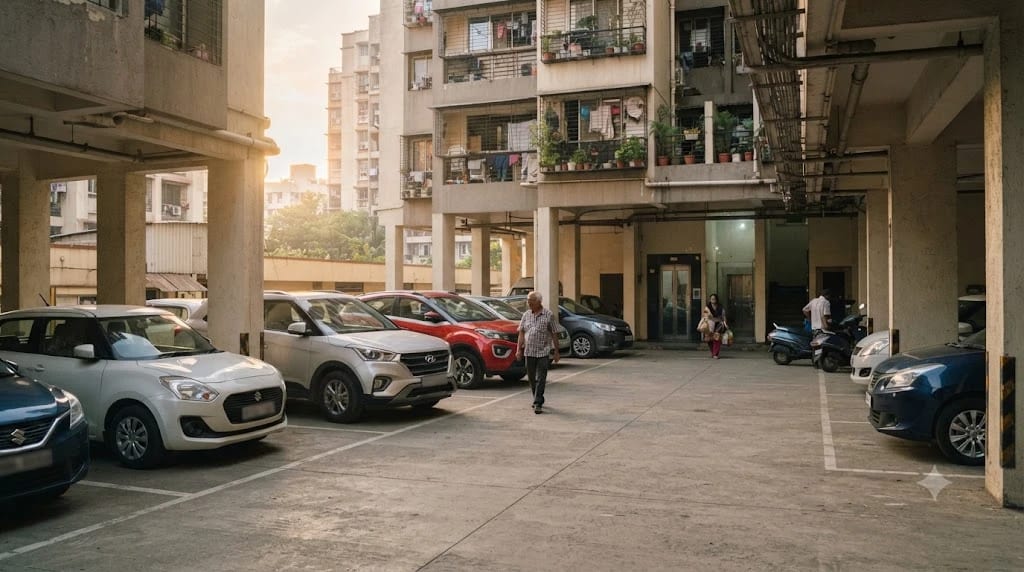
It is 8:34 AM on a Tuesday in a Bangalore high-rise. You are dressed in your work formals, laptop bag over your shoulder, mentally prepping for a 9:30 AM client presentation. You step out of the elevator into Basement 2, only to find a pearl-white Hyundai Creta parked dead center behind your Tata Nexon. Handbrake pulled tight. Wheels straight. No driver in sight.
You tap the Creta's window. Silence. You call the security gate intercom; the guard blows a shrill whistle, shrugs, and tells you he has never seen the car before. You post an angry picture on the society's official WhatsApp group. Three minutes later, the group devolves into an all-caps shouting match between Block A and Block C residents over unassigned slots, visitor spaces, and builder promises.
Road rage solves nothing. In fact, banging on someone's windshield usually guarantees they will not move any faster. Parking disputes are the single biggest source of daily friction in Indian housing societies, from Mumbai co-operative housing societies (CHS) to sprawling gated townships in Noida and Gurgaon.
Before you confront your Resident Welfare Association (RWA) or lose your temper in the basement, you need to know what Indian law actually says about parking spaces, what powers your managing committee holds, and how to stop double-parking headaches without broadcasting your private life to strangers.
What Does Indian Law Say About Apartment Parking Rights?
Under Indian law and the Real Estate (Regulation and Development) Act (RERA) 2016, builders cannot sell open or stilt parking spaces to buyers. Section 2(n) defines parking areas as common amenities that automatically transfer to the society's association of allottees upon project handover.
This legal position was settled well before RERA took effect. In the landmark judgment Nahalchand Laloochand Pvt. Ltd. vs. Panchali Co-operative Housing Society Ltd. (2010), the Supreme Court of India held that stilt parking spaces are not independent "flats" or standalone real estate units. A builder has zero legal right to sell stilt or open parking spaces through independent sale agreements.
Section 17 of RERA reinforces this principle. The promoter must execute a registered conveyance deed transferring the undivided title of common areas—including parking infrastructure—to the registered society or RWA. If your builder charged you ₹3 lakh to ₹5 lakh on a separate informal receipt for an open stilt bay, that transaction is legally void under Indian real estate law.
Open vs. Stilt vs. Covered Basements: What Do You Actually Own?
Flat owners do not own the physical ground or concrete slab beneath their parked car. You purchase an exclusive right of usage (easement) for an earmarked covered or basement space, while open surface parking remains part of the society's shared common property.
To understand your parking status, separate the three distinct categories recognized under municipal building bylaws across Indian cities:
- Open Surface Parking: Paved outdoor spaces on the ground level. These belong to the common pool. The RWA controls their allocation. No builder or resident can claim exclusive permanent ownership over open bays.
- Stilt Parking: Partially covered ground-floor spaces supported by building pillars. If earmarked in the sanctioned architectural plan and formally assigned in your allotment letter, you hold exclusive usage rights. However, the land beneath remains common undivided share of land (UDS).
- Multi-Level Basement Garages: Fully enclosed underground parking levels. Basements require heavy capital expenditure for ventilation and fire safety systems. Builders can allot these as earmarked exclusive bays as part of the composite flat package, but they cannot sell them to third parties who do not own a flat in the building.
Can an aggressive RWA committee take away your basement slot? If your registered sale agreement and allotment plan show a numbered basement bay sanctioned by the municipal authority, the managing committee cannot arbitrarily reassign it to someone else.
Can RWAs Ban Tenants or Charge Them Extra for Parking?
No. RWAs cannot ban tenants from using parking slots or impose discriminatory parking fees on them. A tenant inherits the full usage rights and easements of the flat owner through the registered lease agreement under state apartment ownership laws.
Managing committees frequently overstep by targeting tenants. You will see notices stating that tenants driving an extra Maruti Swift or Mahindra Thar must pay ₹2,000 monthly, while flat owners pay nothing. The Maharashtra Cooperative Societies (MCS) Act and rulings across consumer forums in Delhi, Pune, and Bangalore have repeatedly confirmed that differential maintenance or parking fees for tenants are illegal.
If the owner of flat 402 holds an allotted parking bay, the tenant occupying flat 402 possesses the undisputed right to park their vehicle in that exact bay. The RWA has no legal authority to intervene.
Are Wheel Clamps, Jammers, and Society Towing Legal in India?
Residential housing societies cannot impound, tow, or clamp vehicles parked on public roads outside the gate. However, inside private society boundaries, RWAs can clamp wrongly parked vehicles and levy reasonable administrative fines if these penalties are codified in approved society bylaws.
There is a strict boundary here. RWAs often behave like private municipal corporations. While the general body can approve rules to deter repeat offenders from blocking fire hydrants or driveways, they cannot damage personal property.
If a security guard slaps an unpadded, heavy steel wheel clamp onto your alloy wheel and gouges the metal or damages the brake caliper, the society and the managing committee can be held liable for criminal mischief and property damage under the Bharatiya Nyaya Sanhita (formerly IPC Section 427).
Visitor Parking Rules: What Are Societies Required to Provide?
Most municipal building bylaws across India mandate that housing societies reserve between 5% and 10% of their total parking capacity strictly for visitors. RWAs cannot convert these mandatory visitor spaces into permanent paid slots for residents or completely bar guest vehicles.
In reality, visitor bays are a constant flashpoint. In dense complexes across Gurgaon, Noida, and Mumbai, residents with multiple cars quietly park their second vehicle—often a Honda City or an Activa 6G—in designated visitor spots for weeks.
When actual guests arrive, guards turn them away. Visitors are forced to park on narrow public roads outside the gate, leaving their cars exposed to traffic police towing, side-mirror theft, or bumper scratches from passing auto-rickshaws.
An RWA has the authority to regulate visitor slots by limiting continuous parking to 4 to 8 hours and logging entry timestamps, but shutting down visitor parking entirely violates municipal building approvals.
The Hidden Hazard on Your Windshield: The Flat Sticker Privacy Risk
For decades, Indian societies have used basic paper or vinyl stickers to manage parking: "Green Glen Heights - Tower B / Flat 1204 - Ph: 98450XXXXX".
Plastering your flat number, tower, and personal mobile number directly on your windshield is a serious personal privacy risk.
When you drive your car outside the society gates—to a public market, a mall, a highway dhaba, or your office—that sticker broadcasts your private life to every stranger walking past. Anyone can see your home society, your exact tower, and your flat number.
For women driving alone, this setup invites stalking. Data collection agents routinely walk through public parking lots snapping photos of society stickers to compile targeted databases linking names, phone numbers, and luxury addresses. One slip of vinyl turns your car into a mobile billboard for your private home.
How Smart Privacy QR Tags Stop Parking Disputes Without Sacrificing Safety
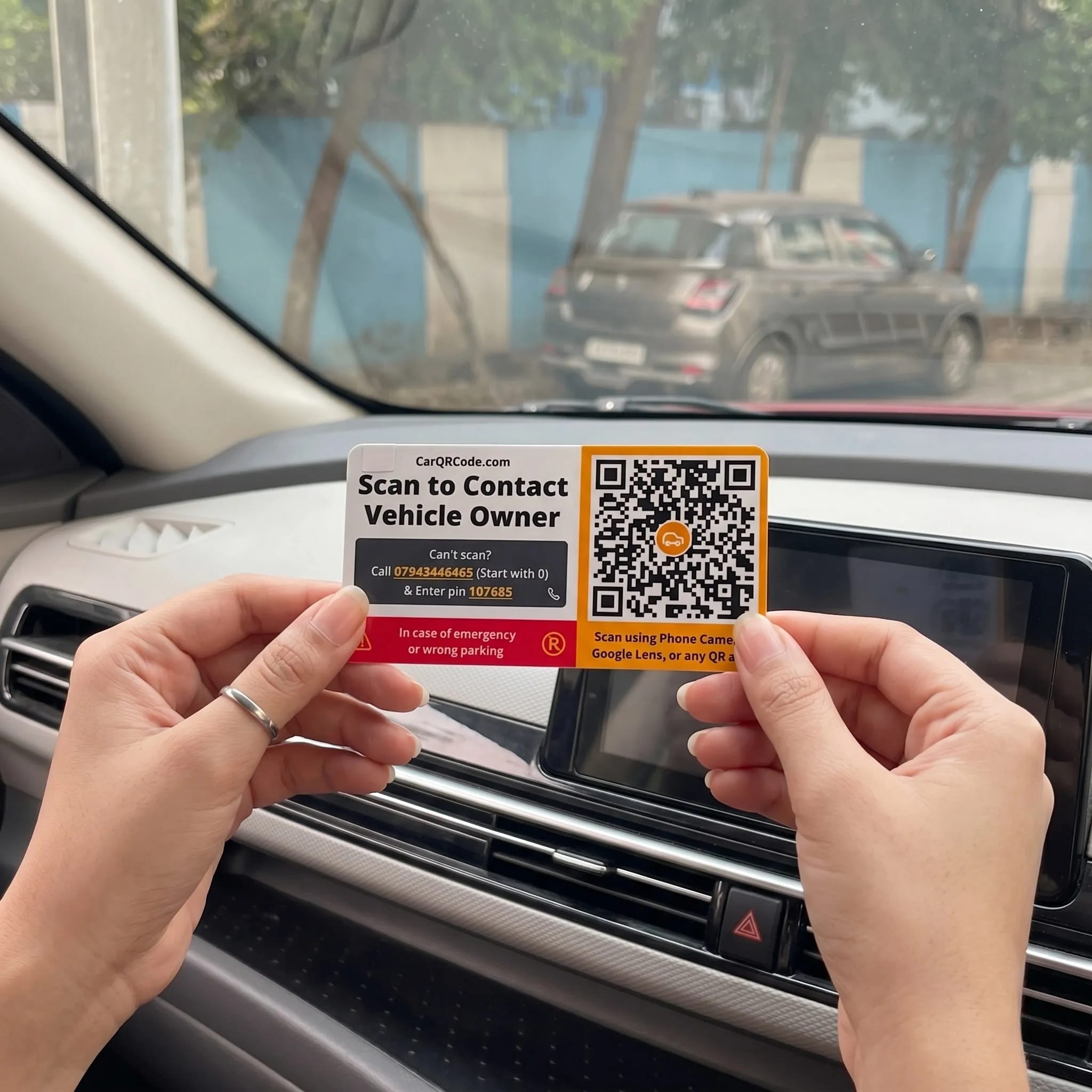
Smart QR tags solve the double-parking problem without revealing your identity. Instead of writing your phone number and flat address across your front glass, you apply an encrypted QR code.
When someone is blocked by your car in the basement, the process is simple:
- The blocked driver or security guard points their phone camera at the sticker.
- They do not need to download a specialized society app or log in.
- The scan opens a secure browser interface that allows them to initiate a masked phone call or send an instant WhatsApp notification: "Your car is blocking another bay. Please move it."
- Your phone number, flat address, and full name remain 100% hidden.
Built from 300-micron waterproof vinyl with cold UV lamination, Abtara QR tags withstand 120-bar pressure washer jets and brutal 45°C Indian summer sun without peeling, fading, or curling at the edges.
| Feature | Traditional Society Paper/Vinyl Sticker | Abtara Smart Privacy QR Tag |
|---|---|---|
| Owner Phone Number | Completely visible to anyone on the road | 100% hidden behind masked routing |
| Tower & Flat Privacy | Exposed on the windshield | Zero society or unit information revealed |
| App Requirement for Caller | None (direct call from windshield) | None (works with any smartphone camera) |
| Notification Channels | Manual phone calls only | Masked voice call + instant WhatsApp alerts |
| Material Durability | Fades, tears, and yellows within months | 300-micron vinyl, cold UV laminated, waterproof |
| Abuse & Spam Protection | Zero (anyone can copy your number) | Built-in rate limiting and anti-harassment shield |
Frequently Asked Questions
Can an apartment association charge visitors for parking?
Yes, an RWA can charge nominal fees for visitor parking if the measure was approved in an Annual General Body Meeting (AGM) to discourage non-residents or commercial vehicles from dumping cars in residential bays for extended periods.
What should I do if an unknown car blocks my allotted parking spot?
First, inform society security to check visitor logs. If the car carries a smart QR tag, scan it immediately to notify the driver. If the vehicle is an unregistered offender and blocks access persistently, file a formal complaint with the managing committee rather than tampering with the vehicle.
Can a builder sell open parking spaces separately under RERA?
No. RERA Section 2(n) and Section 17 strictly forbid builders from selling open or stilt parking spaces. Open bays form part of the project's common areas and automatically belong to the collective association of allottees upon project completion.
Can the RWA tow my car from inside the society premises?
RWAs can contract private recovery trucks to relocate unauthorized vehicles blocking fire exits or driveways, but only if approved in the society bylaws. They cannot seize, impound, or cause physical damage to the vehicle during relocation.
Check your registered sale agreement and municipal allotment plan to verify your exact parking rights before confronting your RWA. If you want to stop basement double-parking headaches without exposing your home address to the entire city, remove that outdated paper slip from your windshield and switch to a privacy-first smart QR tag today.